Growth Creative · Bestie AI
AI Creative Pipeline for Growth
Role
Design, working alongside engineering and growth — I own the visual side and the image-generation logic the AI follows, and designed parts of the operator UI. The multi-agent architecture itself is engineering-led.
Duration
Dec 2025 - Jul 2026
Type
AI Creative Pipeline / Tooling UX
Skills
Visual Spec for AI, Prompt Engineering, Information Architecture, Tooling UX
Tools
Figma, Claude, Cursor, Meta Ads
At Bestie, growth ads are generated by a multi-agent AI pipeline, not drawn by designers. My deliverable was no longer the interface. It was the rules the AI must follow.
A product designer by title, I stepped in when the growth team's pipeline started shipping off-brand at scale: I owned the brand-constraint layer, and contributed to the asset taxonomy and the human-in-the-loop review tools that keep AI-generated ads on-brand.
At a glance
The problems I stepped in to solve
Business problem
My call
What it changed
Business problem
My call
What it changed
Business problem
My call
What it changed
If this role is new to you
It's design work you already know, pointed at a machine
What I did
The design skill you already know
What I did
The design skill you already know
What I did
The design skill you already know
The system
Nine agents, one rule layer
Nine specialised agents cover the creative lifecycle: one diagnoses published ads, three generate static images (iterating winners, proposing new concepts, remaking underperformers), and five more run the video studio chain. I own the visual rule layer that governs all of them, and designed parts of the operator tools around the loop. The agent architecture itself is engineering-led.
The static-image path, where the rule layer does most of its work. The five video agents run a parallel chain under the same constraints.
The loop the diagram abstracts: each generation of variants is scored, and the system keeps the winners and kills the rest. Figures redacted.
Before the rules
The creative was grounded in real users, not guesswork
A pipeline can only enforce rules; a human still has to decide what good creative is. Grounded in the team's user research and competitive analysis, I translated who the user actually is into the ad concepts the pipeline generates, and into what “on-brand” means for it to protect.
Who the ads speak to · de-identified archetypes
Before
After
Every generated ad has to survive this translation: real emotional need in, on-brand creative out. That standard is exactly what the guardrails below defend.
The case · brand drift
When the machine forgets who the brand is
Left unconstrained, the pipeline drifted: character avatars were misused as logos, and product UI was invented by the model instead of being sourced from the real asset library. Each drifted ad quietly eroded brand trust, at generation speed.
The scale problem wasn't one bad ad, it was compounding: the pipeline generates on a daily automated schedule, so a bad rule reproduces its mistake every single morning until someone codifies the fix. I flagged the two failure classes and defined what “correct” looks like; the fix below shipped as a pair with engineering.
The fix
From design spec to prompt constraint
The audience of a design spec changed: it is now read by a model, not a person. I led the fix, translating visual rules into prompt-level hard constraints, turning “the avatar is never a logo” from a guideline humans agree with into an instruction the model cannot ignore (shipped with engineering).
Before
After
Information architecture
Taxonomy as design material
I contributed to a four-category use_case taxonomy for the asset library, so the pipeline could caption and compose assets according to ad context: information architecture in service of model behaviour.
The tools
Human-in-the-loop, by design
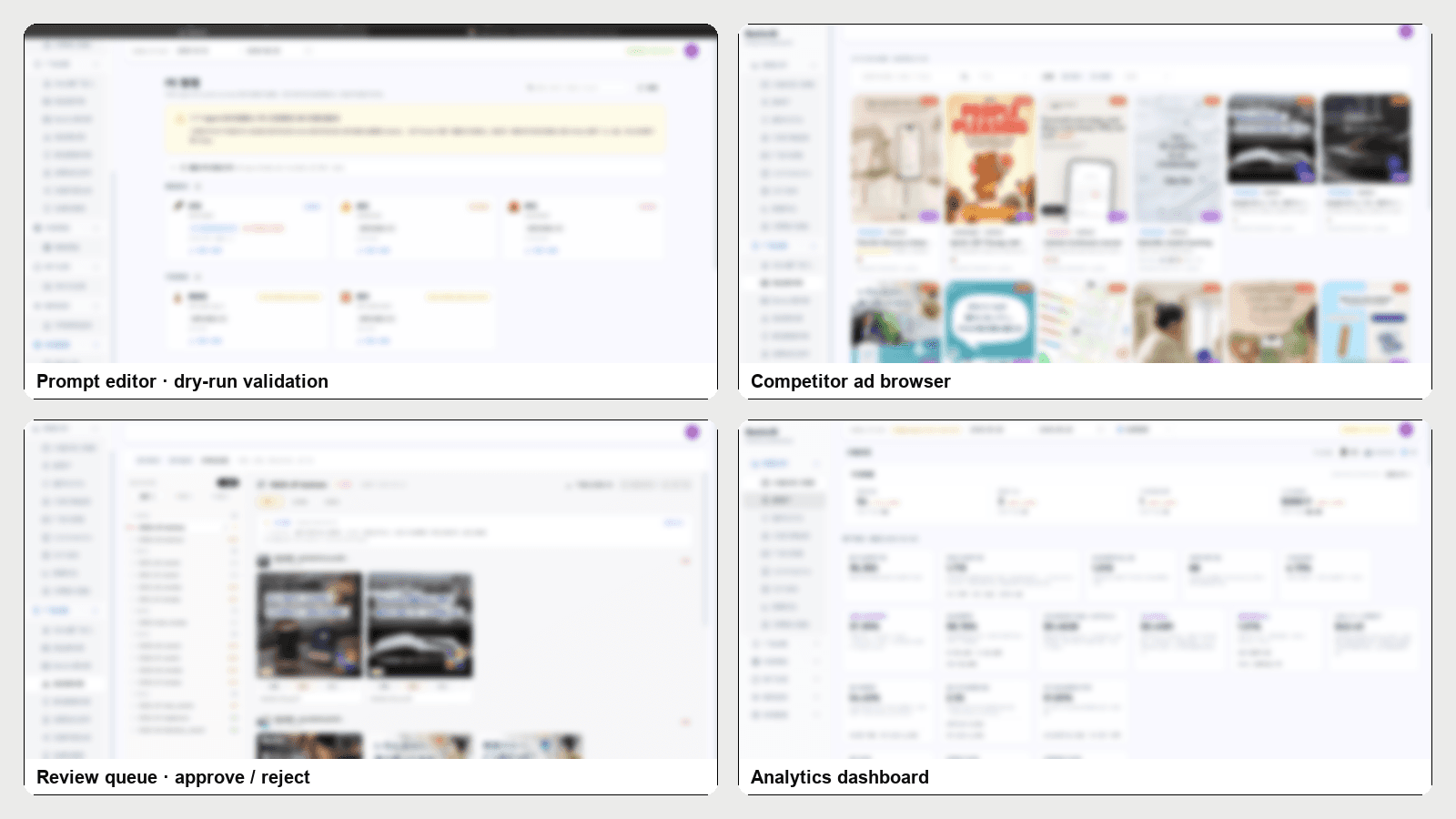
A pipeline is only as reliable as the tools operators use to steer it. I contributed to the design of the operator toolchain: an asset manager with auto-captioning, a prompt editor with dry-run validation, an ad review queue feeding Meta publishing, and a competitor ad browser.
Impact
What the rules changed
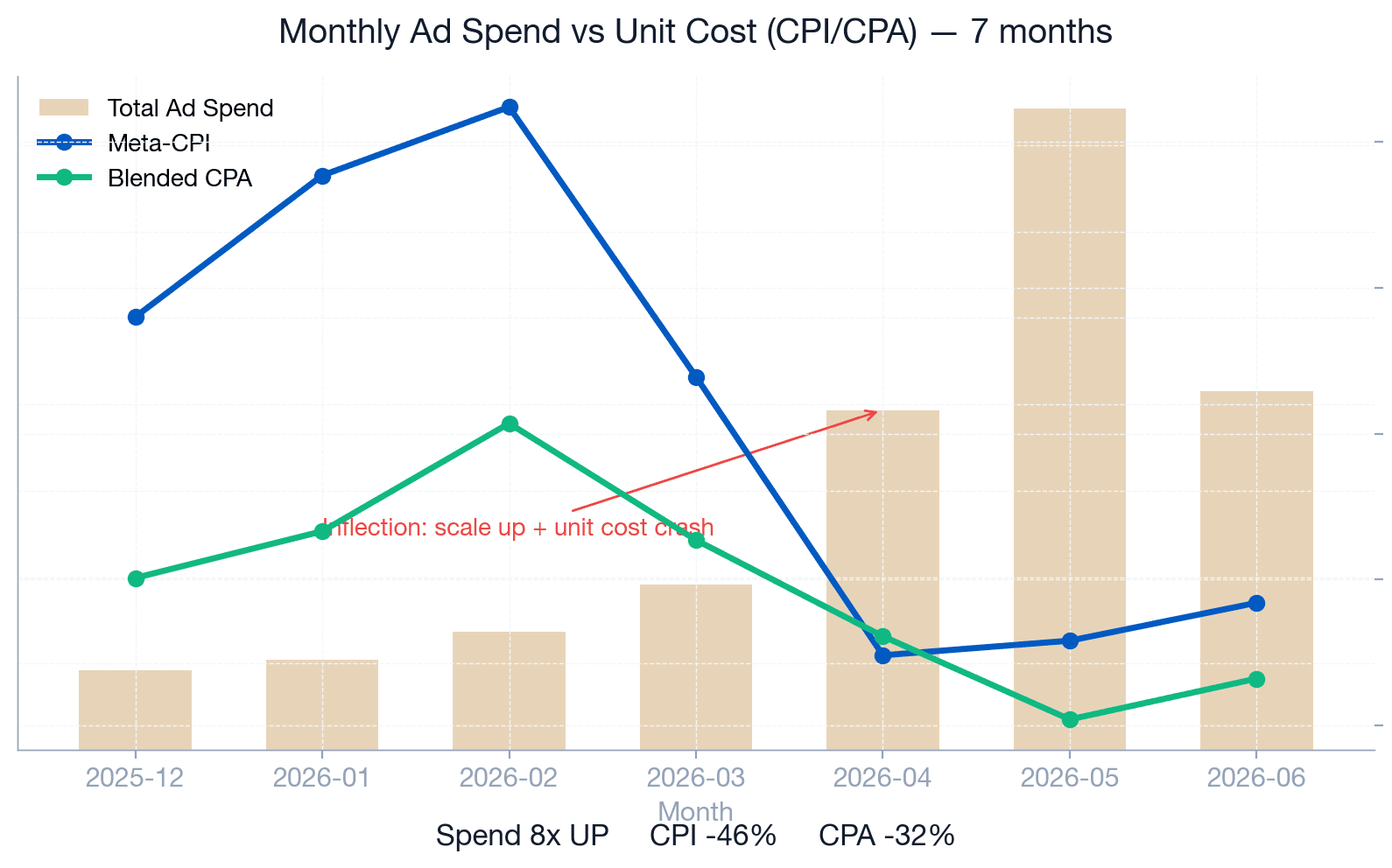
The context these rules protected. Scaling paid growth is a whole team's work, and the numbers below are theirs, not mine — my job was to keep that volume on-brand as it grew. Over seven months monthly ad spend scaled roughly 8x while Meta CPI fell 46% and blended CPA fell 32%.

The rules were accountable to real numbers: this is the analytics surface the growth team steered by. Values redacted.
What designers ship now
Working inside an AI-native team changed my definition of a design deliverable. Rules, taxonomies and constraints are design artifacts too, and the designer becomes a translator between design intent and model behaviour. As more teams put generation inside their creative loop, the ability to write rules a machine can follow, and design the checkpoints where humans stay in control, is becoming its own craft. This is the work I want to keep doing.
The other half of this role, designing the product itself — an AI companion's memory turned into something you can feel — is a separate story: Bestie AI · product design →